Food Cost vs. Labor Cost: What's Actually Killing Your Restaurant's Profit?
OAOn A Wait Hospitality · September 17, 2026 · 4 min read
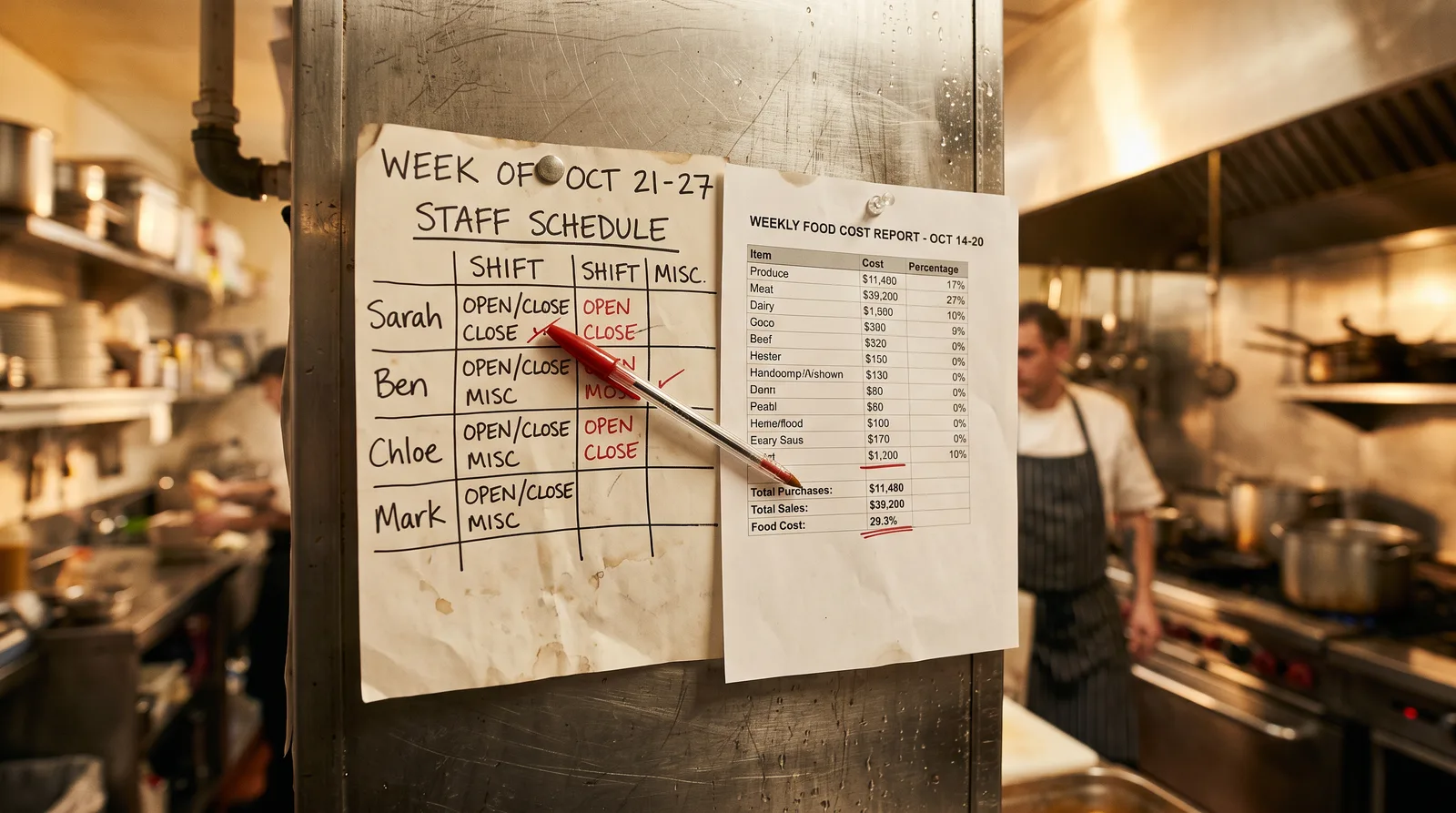
Every new manager I've seen step into a restaurant does the same thing. They zero in on food cost like it's the only number that matters. They count portions, police the line, quiz servers on the menu. All of that matters — don't get me wrong. But while they're watching the walk-in cooler, the schedule on the wall is quietly hemorrhaging profit.
Both food cost and labor cost deserve your attention. The problem is that most operators manage one reactively and the other barely at all. This post is going to show you how to think about both, how to benchmark them properly, and how to find the real leak in your operation.
What "Prime Cost" Actually Means
The restaurant industry uses a term called prime cost, and if you're not building your week around it, you're flying blind. Prime cost is simply:
Cost of Goods Sold (food + beverage) + Total Labor Cost
That's your two biggest controllable expenses combined into one number. Healthy full-service restaurants typically target a prime cost somewhere around 60–65% of total sales. Quick-service concepts can push that lower. If yours is running above 70%, something is wrong — and it's probably not just the food.
Getting that percentage is straightforward:
- Pull your total food and beverage costs for the week (what you actually used, not what you ordered).
- Pull your total labor — wages, payroll taxes, and any benefits you're paying out.
- Divide the combined number by your total revenue for the same period.
- Multiply by 100.
That single percentage tells you more about your restaurant's health than a dozen other metrics.
Food Cost: Where the Real Benchmarks Live
A blanket "food cost should be 28–32%" is a starting point, not a rule. Your actual target depends on your concept, your price point, and your menu mix.
Here's how to sharpen that number for your operation:
Calculate theoretical vs. actual food cost. Your theoretical food cost is what you should spend based on your recipes and sales mix. Your actual food cost is what you did spend based on your inventory. The gap between those two numbers tells you exactly how much waste, theft, over-portioning, or spoilage you have. If your theoretical is 29% and your actual is 34%, you have a 5-point problem — and now you can hunt it down.
Watch your menu mix, not just your total. A busy Saturday selling mostly high-food-cost steaks will look different from a Tuesday with high-margin pasta sales. Know which items are pulling your cost up and price them accordingly — or feature your high-margin items more deliberately.
Labor Cost: The Leak Most Managers Don't See
Labor is harder to manage than food for one simple reason: it has feelings. Cutting someone's hours is uncomfortable. Sending someone home early creates tension. So managers avoid it, and the schedule bloats.
Here's the framework I teach for keeping labor honest:
Set a labor budget before you write the schedule — not after. Take your projected sales for the week, multiply by your labor cost target (let's say 30%), and that's your dollar budget. Now build your schedule to fit inside that number. Most managers write the schedule based on habit or availability and then check the percentage afterward. That's backwards.
Track hours by daypart, not just weekly totals. A restaurant can hit its labor target for the week and still be wildly overstaffed on Tuesday lunch and understaffed on Friday dinner. Break your labor tracking down into shifts. Compare scheduled hours to actual hours worked. Look for patterns.
Know your labor cost per cover. Divide your total labor cost for a shift by the number of guests served. If that number spikes on a slow night, you had too many people on the floor for the volume. This metric cuts through excuses fast.
Balancing the Two Without Breaking Your Team
Here's the tension nobody talks about: cutting labor too hard to fix a food cost problem is a trap. Fewer hands on the line often means more mistakes, more waste, and lower guest satisfaction — which costs you revenue. The numbers interact.
The goal isn't to minimize each cost in isolation. It's to run a lean, well-staffed operation where both costs are appropriate for your volume. That means:
- Cross-training staff so you can flex coverage without over-hiring
- Scheduling your strongest people during your highest-volume shifts (where they generate the most return)
- Reviewing both numbers weekly, together, as a pair — not in separate silos
The One Habit That Changes Everything
Pull your prime cost every single week. Not monthly. Not when corporate asks. Every week, so the trend is visible before it becomes a crisis. Food cost and labor cost are not enemies — they're two dials on the same machine. Learn to tune them together and you'll run a restaurant that actually makes money, not just one that stays busy.
If you want to go deeper on this — building the actual systems, mastering the scheduling models, and understanding every lever that affects your bottom line — that's exactly what we cover in Food and Beverage Management.

Want to go deeper than a blog post?
Hospitality Operations - Food and Beverage Management
Master every layer of running a profitable restaurant — from kitchen operations and staff leadership to cost control and guest experience. Turn chaos into a smooth, money-making machine.
Start learning — $397 · 30 days access